July 12th, 2013
serves 4 to 6
8 ounces spaghetti
1/2 cup pesto
8 ounces spinach
2 cups edamame (shelled and shucked, the peas, not entire pods)
juice from 2 lemons (plus fresh lemon wedges for serving)
3/4 cup almonds, crushed and lightly toasted
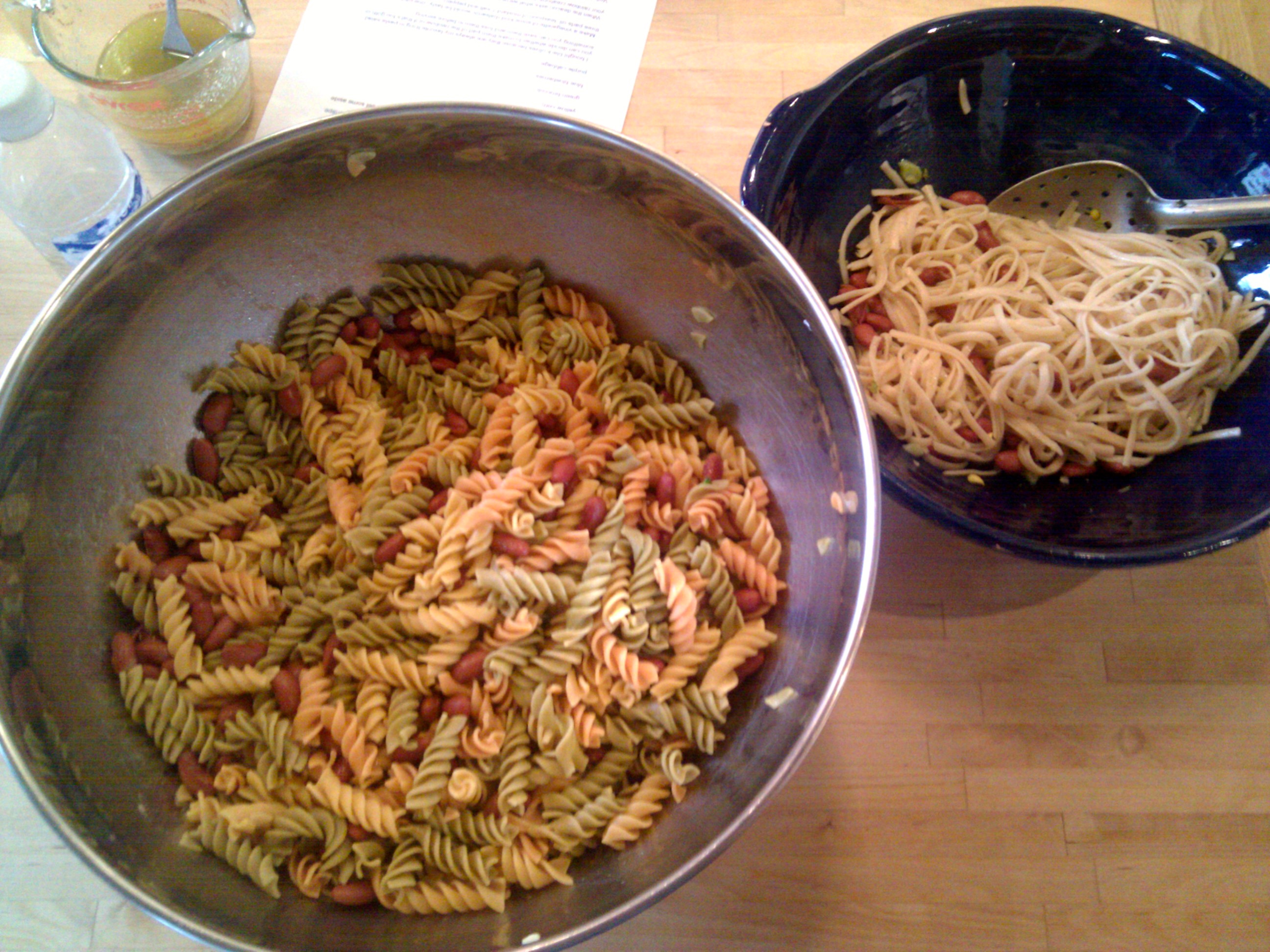
Heat a large pot of water to boiling, cook pasta until al dente. Remove from water, strain and rinse with cold water. In a large bowl, stir pasta, pesto and spinach until combined (some spinach will wilt, some will stay firm — this is a nice contrast of textures). Finally, stir in the edamame and squirt the lemon all over the finished dish. Reserve a few lemon slices for people to add more if they like. On a low heat, toast crushed almonds until just fragrant. Garnish pasta with the toasted almonds.
–Prepared with our help by Katherine and Jane on July 7 and 8, 2013 at St. Lydia’s
July 12th, 2013
by Denise Levertov
The clouds as I see them, rising
urgently, roseate in the
mounting of somber power
surging in evening haste over
roofs and hermetic
grim walls—
Last night
as if death had lit a pale light
in your flesh, your flesh
was cold to my touch, or not cold
but cool, cooling, as if the last traces
of warmth were still fading in you.
My thigh burned in cold fear where
yours touched it.
But I forced to mind my vision of a sky
close and enclosed, unlike the space in which these clouds move—
a sky of gray mist it appeared—
and how looking intently at it we saw
its gray was not gray but a milky white
in which radiant traces of opal greens,
fiery blues, gleamed, faded, gleamed again,
and how only then, seeing the color in the gray,
a field sprang into sight, extending
between where we stood and the horizon,
a field of freshest deep spiring grass
starred with dandelions,
green and gold
gold and green alternating in closewoven
chords, madrigal field.
Is death’s chill that visited our bed
other than what it seemed, is it
a gray to be watched keenly?
Wiping my glasses and leaning westward,
clearing my mind of the day’s mist and leaning
into myself to see
the colors of truth
I watch the clouds as I see them
in pomp advancing, pursuing
the fallen sun.
–Read at St. Lydia’s on July 8, 2013
July 3rd, 2013
by Mark Doty
You weren’t well or really ill yet either;
just a little tired, your handsomeness
tinged by grief or anticipation, which brought
to your face a thoughtful, deepening grace.
I didn’t for a moment doubt you were dead.
I knew that to be true still, even in the dream.
You’d been out–at work maybe?–
having a good day, almost energetic.
We seemed to be moving from some old house
where we’d lived, boxes everywhere, things
in disarray: that was the story of my dream,
but even asleep I was shocked out of the narrative
by your face, the physical fact of your face:
inches from mine, smooth-shaven, loving, alert.
Why so difficult, remembering the actual look
of you? Without a photograph, without strain?
So when I saw your unguarded, reliable face,
your unmistakable gaze opening all the warmth
and clarity of you–warm brown tea–we held
each other for the time the dream allowed.
Bless you. You came back, so I could see you
once more, plainly, so I could rest against you
without thinking this happiness lessened anything,
without thinking you were alive again.
–Read at St. Lydia’s on June 30 and July 1, 2013
July 3rd, 2013
Ingredients:
rotini pasta (we used “garden” flavored for the variety of colors)
balsamic vinegar
olive oil
s + p
mustard
grated parmesan for serving
parsley or cilantro
a variety of beans, fruits and vegetables for color. We used:
red-peppers, tomatoes, beans, strawberries
orange-carrots
yellow-corn
green-broccoli
blue-blueberries
purple-cabbage
black olives, because its not pasta salad without them
-Boil the pasta in salted water, toss with a little olive oil and keep it in a separate bowl. Jane added the beans to the pasta since we had so many other red things. We also made some with gluten-free pasta.
-Chop the broccoli into florets and blanch in boiling water for 1-2 mins and transfer to an ice bath to preserve greenness and crunchiness.
-Then boil the corn for five minutes in the same water, let cool and cut kernels off cobbs.
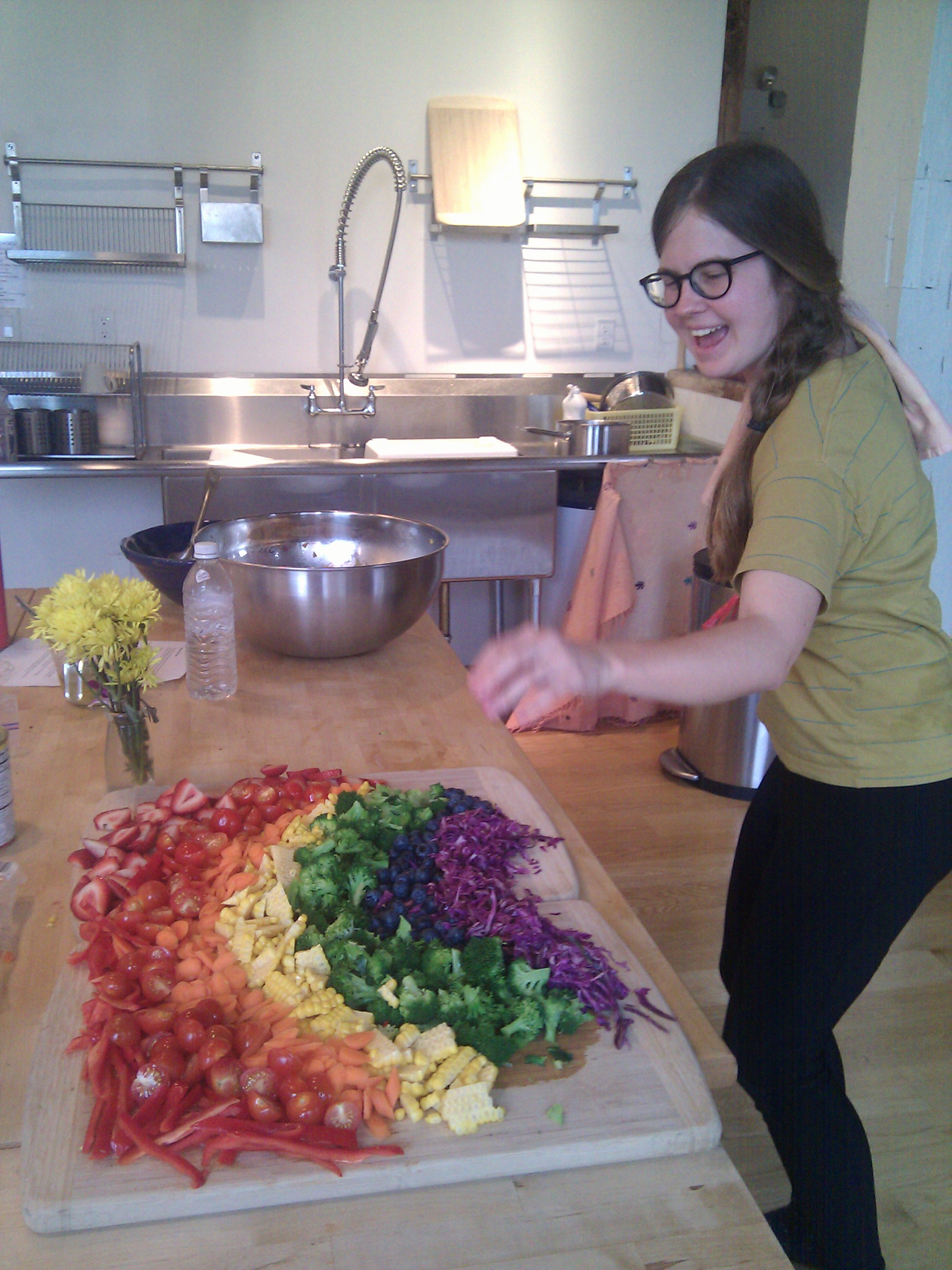
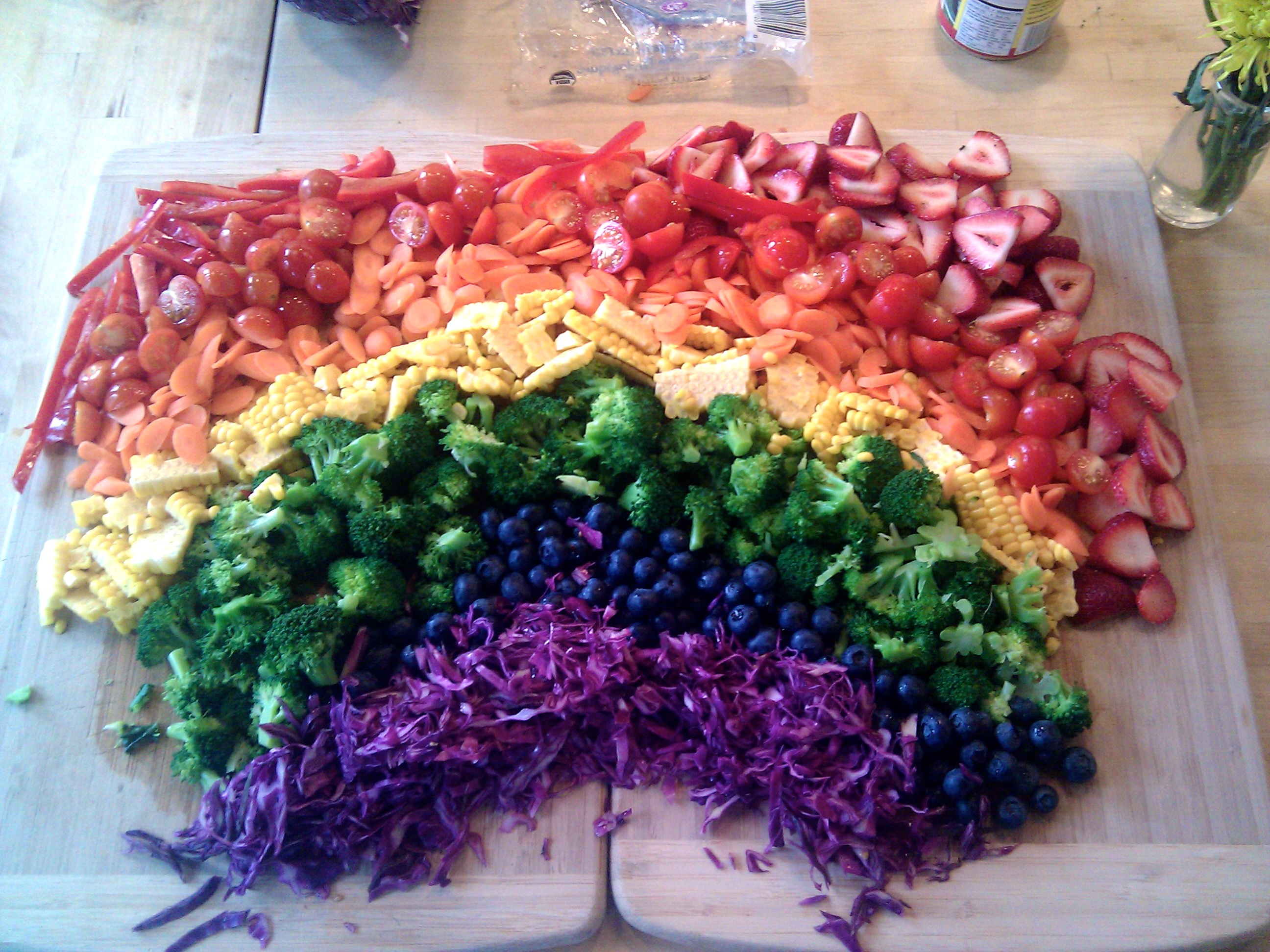
-chop the rest of the ingredients, and lay them out on platters in a rainbow shape.
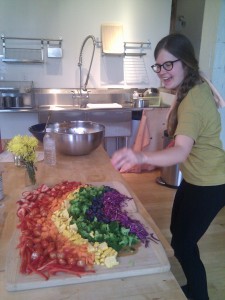
-Make a vinegarette–one part vinegar, three parts oil, teaspoon of mustard + salt and pepper (Jane added crushed garlic for extra flav and it was great).
-Toss everything together, once everyone present has had a chance to admire your rainbow. 🙂
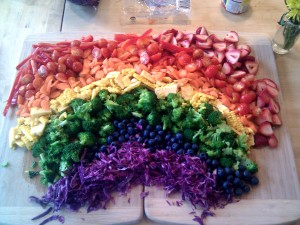
–Prepared with our help by Mabel and Jane on Sunday June 30 and Monday July 1, 2013 at St. Lydia’s, in hope for marriage equality for all.
June 28th, 2013
by Walt Whitman
O me, man of slack faith so long!
Standing aloof—denying portions so long;
Only aware to-day of compact, all-diffused truth;
Discovering to-day there is no lie, or form of lie, and can be none, but grows as inevitably upon itself as the truth does upon itself,
Or as any law of the earth, or any natural production of the earth does.
(This is curious, and may not be realized immediately—But it must be realized;
I feel in myself that I represent falsehoods equally with the rest,
And that the universe does.)
Where has fail’d a perfect return, indifferent of lies or the truth?
Is it upon the ground, or in water or fire? or in the spirit of man? or in the meat and blood?
Meditating among liars, and retreating sternly into myself, I see that there are really no liars or lies after all,
And that nothing fails its perfect return—And that what are called lies are perfect returns,
And that each thing exactly represents itself, and what has preceded it,
And that the truth includes all, and is compact, just as much as space is compact,
And that there is no flaw or vacuum in the amount of the truth—but that all is truth without exception;
And henceforth I will go celebrate anything I see or am,
And sing and laugh, and deny nothing.
–Read at St. Lydia’s on June 24, 2013
June 28th, 2013
by Walt Whitman
When I heard the learn’d astronomer;
When the proofs, the figures, were ranged in columns before me;
When I was shown the charts and the diagrams, to add, divide, and measure them;
When I, sitting, heard the astronomer, where he lectured with much applause in the lecture-room,
How soon, unaccountable, I became tired and sick;
Till rising and gliding out, I wander’d off by myself,
In the mystical moist night-air, and from time to time,
Look’d up in perfect silence at the stars.
–Read at St. Lydia’s on June 23. 2013
June 21st, 2013
by Shannon Elizabeth Hardwick
Light, what will remain of my body, talks
about You. It keeps saying,
learn each other–Today
I asked a stranger
if she was like me, did she
speak into a tape recorder
love-notes to herself to keep
from diving, driving, into
the shale-pain of road.
When she answered, Yes–
Light, the earth, let me
live on the ground again.
–Read at St. Lydia’s on June 16 and 17, 2013
June 21st, 2013
We subsituted almonds and they were delicious!
1 cup uncooked quinoa
1/2 cup macadamia nuts
1 small garlic clove, minced
1 small green onion, thinly sliced
3/4 cup seeded diced cucumber
1 cup diced green apple
1/2 cup diced green bell pepper
1/4 cup diced celery
1/2 red serrano chile, seeded and thinly sliced
Juice of 1 lemon
Agave nectar
2 tablespoons plain yogurt
Maldon or other flaky salt
1. Prepare the quinoa according to the package directions. Put the drained quinoa back into the pot and stir it over low heat to remove some of the moisture.
2. In a small dry skillet, toast the macadamia nuts over medium-low heat until evenly browned, 3 to 4 minutes, stirring often to keep them from burning. Crush the nuts lightly with a knife.
3. In a large bowl, combine the quinoa, macadamia nuts, and the remaining ingredients. Toss and check for seasoning; add more lemon juice and salt if necessary.
–Prepared with our help by Katherine and Mabel on June 16 and 17, 2013
June 19th, 2013
Hello, Song Leaders and all interested in music at Saint Lydia’s!
Our list of songs is ever growing, and from time to time, people have ideas for a song that they would like to add to the Lydian repertoire. If you have a song suggestion, the first step is to send a recording of the song (or a YouTube link) to Emily to see if it’s a good match for Saint Lydia’s. Here’s a sort of informal list of criteria used to select songs for St. Lydia’s:
It’s a simple song that can be taught easily by ear and repeated.
It has a beautiful, well-constructed melody that is pleasurable to sing. Despite the simplicity, the song is rich. It’s not campy or cheesy. The ability to harmonize it intuitively is an added bonus.
It’s a song that feels familiar or comes from somewhere far away. We try to sing songs from all around the world, as a way of connecting with the global community of Christians.
It doesn’t require an accompaniment like piano or guitar for the melody to “make sense.” Some pieces don’t really hold together without the accompaniment, which adds a whole lot to the melody. The song “Taste and See,” is an example of this. It is a gorgeous song, but needs the accompaniment to work.
It’s meant to be sung by a group of people, not by a solo voice. For instance, a group of people singing a song that’s really virtuosic doesn’t work so well. This places a theological focus on the body of Christ united in song, rather than on the individual performer. Our national anthem is a good example of this — it sounds better sung solo then by a group. However, some songs have simple refrains for the congregation to sing, and then a virtuosic solo line over the top, which is great — the body is included and the gifts of the individual are lifted up.
It has theology that connects with the theologies we’re exploring at St. Lydia’s, which holds humans and humanity up as broken but fundamentally good and created by God, and focuses on God’s love and goodness rather than God’s judgment. It stays away from militaristic images in which Christ as a conqueror. For instance, the Easter hymn “Thine is the Glory” goes, “Thine is the glory, risen, conquering son, endless is the victory, thou o’er death hast won,” which subtly turns Christ into a warrior. This is certainly one way to imagine him, but not the image we choose to focus on at St. Lydia’s.
It stays away from using male language for God, so that the image of God in our mind is free to be female, male, or gender neutral. Sometimes it’s easy enough to change a “him” to a “you” or a “God.” Emily is always willing to help if you’d like to adapt the language of a song.
It avoids telling the singer how to feel. For instance, if you arrive at church and have just lost your job and are at the end of your rope and the first song starts with the line, “We are joyful we are glad…” that makes it feel like there’s no room for your emotions. We learn how to praise and sing Alleluia even in the midst of grief, but we avoid texts that seem to tell people how to feel or imply that they should always feel happy.
Suggestions for new songs are always welcome!
–Jacob Slichter
Find more Resources for Song Leaders and Song-leader trainees here!
June 19th, 2013
Hello, Song Leaders!
As you go deeper into the practice of song leading, you may begin to see that song leading is a spiritual practice. Here is some of the thinking from which the Saint Lydia’s song-leading practice has emerged.
With the exception of our final hymn, all of the music that the congregation sings at a Saint Lydia’s service is sung without written music. It’s paperless. Why is that?
Among other things, paperless music . . .
allows everyone to sing with full confidence, especially those who don’t read music.
allows us to look up and see each other instead of looking down at a sheet of music.
By teaching the songs without written music, the Song Leader thus invites everyone into community. Thus, song leading becomes a powerful act of hospitality.
In addition to inviting all to sing, the Song Leader invites all to share authority. You can think of it this way:
By stepping forward to sing, the Song Leader moves simply and whole-heartedly into leadership. As she courageously offers personal authority through bold gestures and clear singing, she is taking a risk for the sake of the group. She is making a gift to the group and inviting us to see how graceful community works.
The Song Leader listens well when leading and holds the group’s voice and learning lovingly.
The Song Leader listens and feels for the group’s readiness to take their own authority and moves to sharing the shaping of the music or, except when song leadership requires it (e.g. call and response) offers body language—stepping back into the larger circle of singers, for example—to express that the leader and the group are sharing authority.
A community where all are welcome and where authority is shared—that’s what Song Leaders us to become every time we sing. It’s all communicated through eye contact and gesture, and it’s powerful stuff!
If you would like to know more about this kind of communal music making, talk to Rachel, Emily, or Jake.
You might also think about attending a Music That Makes Community workshop. For more info, visit musicthatmakescommunity.org.
–Jacob Slichter
Find more Resources for Song Leaders and Song-leader trainees here!